

Pink foam in the sink is the most ignored symptom in dentistry. Most people assume they brushed too hard, switch to a softer brush, and move on — while the actual cause, a bacterial infection along the gumline, keeps working quietly. Gum disease is the leading cause of adult tooth loss, and it rarely hurts until it has already done permanent damage.
At Arrow Dental Arts, our Dentist In Rancho Cucamonga team sees the same pattern every week: a patient with no pain, no visible problem, and bone loss that has been progressing for years. This guide covers what is actually happening, how each stage is treated, and the daily habits that measurably lower your risk.
Key takeaways
- Bleeding gums are a sign of inflammation, not of brushing too hard.
- Gingivitis is fully reversible; periodontitis is not, but it can be stopped.
- About 4 in 10 U.S. adults aged 30 and older have some form of periodontitis, according to the CDC.
- Pocket depth measurements find bone loss years before you can feel it.
- Twice-daily brushing plus daily cleaning between teeth is the core of prevention — everything else is support.
Why do your gums bleed when you brush?
Gums bleed because dental plaque — a sticky film of bacteria — sits against the gumline and triggers inflammation. The tissue becomes swollen and fragile, so the light pressure of a toothbrush breaks tiny blood vessels. Brushing less is the wrong response; cleaning the area thoroughly is what makes it stop.
Plaque re-forms within hours, and after a couple of days it hardens into tartar, which sits above and below the gumline and cannot be brushed away — only a professional cleaning removes it.
Bleeding that continues for more than two weeks despite good hygiene deserves an exam — in a Dentist In Rancho Cucamonga office, that usually means measuring pocket depths around every tooth rather than simply looking at the gums.
The four stages of gum disease
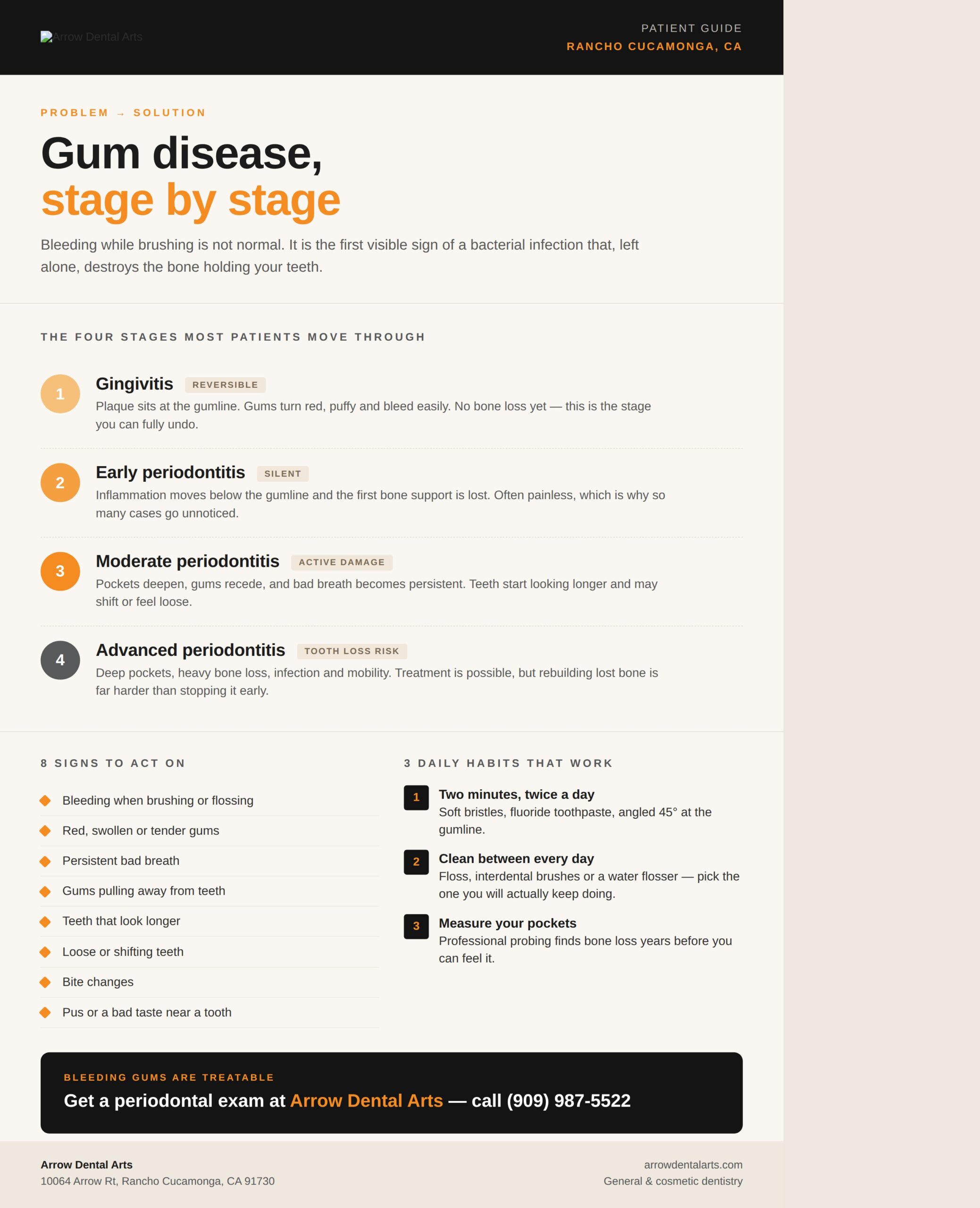
Gum disease is not a single condition; it is a progression. Knowing the stage tells you what treatment can realistically achieve.
| Stage | What is happening | Reversible? | Typical treatment |
|---|---|---|---|
| Gingivitis | Plaque at the gumline; redness, puffiness, bleeding. No bone loss. | Yes, fully | Professional cleaning plus improved home care |
| Early periodontitis | Inflammation below the gumline; first attachment and bone loss. Usually painless. | No, but stoppable | Scaling and root planing, re-evaluation in 4–6 weeks |
| Moderate periodontitis | Deeper pockets, recession, persistent bad breath, some tooth mobility. | No | Deep cleaning, possible localized antibiotics, more frequent maintenance |
| Advanced periodontitis | Severe bone loss, deep pockets, drifting or loose teeth, infection. | No | Surgical therapy, regenerative procedures, sometimes extraction and replacement |
The clinically important number is pocket depth. Healthy sulcus measurements are generally 1–3 mm; 4 mm or more suggests attachment loss and needs monitoring. That is why a quick visual check is not enough — it cannot see bone.

What raises your risk
Gum disease needs bacteria to start, but several factors decide how fast it moves. Smoking is the strongest modifiable one: it constricts blood flow to the gums, which both accelerates destruction and hides the bleeding that would normally warn you. Poorly controlled diabetes raises risk in both directions — high blood sugar worsens inflammation, and inflammation makes glucose harder to control.
Other contributors include hormonal changes during pregnancy and menopause, medications that cause dry mouth, genetic predisposition, clenching and grinding, a sugary diet and chronic stress. Gum disease is also associated with cardiovascular disease and adverse pregnancy outcomes — one more reason not to treat it as cosmetic.
How gum disease is treated
Treatment is staged to match the diagnosis, and it always starts with the least invasive option that will work.
Scaling and root planing
Often called a deep cleaning, this removes tartar from below the gumline and smooths the root surface so tissue can reattach. It is usually done with local anesthetic, often one half of the mouth at a time.
Surgical care
When pockets stay deep after nonsurgical treatment, flap surgery or bone and tissue grafting may be recommended — handled in-house by our periodontal specialist.
Maintenance
This is the part patients underestimate. After active treatment, periodontal maintenance every three to four months is what keeps the disease inactive. Skipping it is the most common reason gums relapse.
9 daily habits that protect your gums
- Brush for two full minutes, twice a day with a soft-bristled brush and fluoride toothpaste, angling the bristles 45 degrees into the gumline.
- Clean between your teeth every single day. Floss, interdental brushes or a water flosser — the one you will actually use consistently.
- Do not brush right after acidic drinks. Wait about 30 minutes so softened enamel is not scrubbed away.
- Use a tongue scraper or brush your tongue to cut the bacterial load that drives bad breath and re-colonization.
- Stop smoking or vaping. This is the single highest-impact change for gum health.
- Keep blood sugar steady if you have diabetes or prediabetes, and tell your dentist about any change in your A1c.
- Drink water instead of sweet drinks between meals, and rinse with water after snacks when brushing is not possible.
- Replace your brush head every three months, and after any illness.
- Keep your professional appointments. A checkup catches a 4 mm pocket long before it becomes a 7 mm one.
When to call a dentist
Book an exam if you notice bleeding that persists beyond two weeks, gums that have visibly pulled away from a tooth, persistent bad breath that does not respond to hygiene, a loose tooth, a change in how your bite feels, or any pus or bad taste near a tooth. Swelling with fever is urgent — call (909) 987-5522 the same day.
Patients searching for a Dentist In Rancho Cucamonga often arrive after years of intermittent bleeding. The good news is that even moderate disease responds well to treatment; the earlier the measurement happens, the more support can be saved.
Bleeding gums are treatable — start with an answer
Arrow Dental Arts · 10064 Arrow Rt, Rancho Cucamonga, CA 91730 · Mon–Fri, 8:00 AM–5:00 PM
Frequently asked questions
Can gum disease be cured?
Gingivitis can be reversed completely. Periodontitis cannot be cured once bone support is lost, but it can be stopped and maintained so teeth remain stable for decades.
How often should my gums be checked?
Most adults need a checkup and cleaning every six months. Anyone with a history of gum disease is usually placed on a three- to four-month maintenance schedule.