

Key Takeaways
- A dental emergency is any situation with severe pain, uncontrolled bleeding, swelling, or a knocked-out, loose, or broken permanent tooth.
- A knocked-out adult tooth can often be saved — hold it by the crown, keep it moist (in milk or inside the cheek), and reach a dentist within 30–60 minutes.
- For most dental emergencies, call your dentist first; go to the ER only for facial swelling affecting breathing/swallowing, uncontrolled bleeding, or major facial trauma.
- Never place aspirin directly on a tooth or gum — it burns tissue. Use a cold compress and over-the-counter pain relief as directed instead.
- Arrow Dental Arts — the Dentist In Rancho Cucamonga known for same-day emergency care — reserves time daily for urgent patients.
Dental emergencies are defined by three things: severe pain, swelling, or trauma to a tooth. A knocked-out tooth, a cracked crown, or a throbbing abscess can’t wait — and what you do in the first hour often decides whether a tooth is saved or lost. This guide from Arrow Dental Arts, your recommended Dentist In Rancho Cucamonga, covers exactly what to do (and what never to do) for the most common dental emergencies before you reach our office.
Table of Contents
1. Knocked-Out (Avulsed) Tooth
What to do: Time is everything — a knocked-out adult tooth has the best chance of being re-implanted within 30–60 minutes.
- Find the tooth and hold it by the crown (the white chewing surface) — never touch the root.
- If it’s dirty, rinse gently with water for a few seconds. Do not scrub or use soap.
- Try to reinsert it into the socket and bite gently on gauze. If you can’t, keep it moist in a cup of milk, saline, or inside your cheek. Never let it dry out.
- Get to the dentist immediately and tell the front desk it’s a knocked-out tooth.
Children’s baby teeth should not be reimplanted — doing so can damage the developing permanent tooth. Bring the child and the tooth to us and let our doctors evaluate.
2. Cracked, Chipped, or Broken Tooth
Rinse your mouth with warm water and place a cold compress on the cheek to limit swelling. If you find any fragments, keep them moist and bring them in — sometimes they can be bonded back. Avoid chewing on that side, and skip very hot or cold foods. Small chips are usually fixed with bonding in one visit; larger breaks may need a crown, and a crack that hurts on release of a bite needs prompt evaluation before it reaches the nerve.
3. Severe Toothache or Dental Abscess
What to do: Rinse with warm salt water, floss gently to remove anything trapped between teeth, and take an over-the-counter pain reliever as directed on the label. A cold compress on the outside of the cheek helps with throbbing.
Never: place aspirin or rubbing alcohol directly against the gum or tooth — it causes chemical burns — and don’t apply heat, which can draw infection outward.
Swelling of the gum, face, or jaw; a pimple-like bump on the gum; fever; or a bad taste means infection. A dental abscess does not resolve on its own and can spread — it needs drainage and treatment (usually a root canal or extraction) as soon as possible. Our office keeps same-day emergency slots open every day.
4. Lost Filling or Crown
Keep the area clean and avoid sticky or hard foods. Drugstore temporary filling material (available at most pharmacies) can cover the cavity until your visit. If you still have the crown, bring it — a well-fitting crown can often be re-cemented the same day. A lost filling exposes the nerve-containing layers of the tooth, so don’t wait weeks; sensitivity and fracture risk rise quickly.
5. ER or Dentist? Where to Go
Go to the emergency room only if you have: facial swelling that affects breathing or swallowing, bleeding that won’t stop, a jaw injury or suspected fracture, or trauma with loss of consciousness. For everything else — toothaches, knocked-out teeth, cracks, lost crowns — the dentist is the right destination. Emergency rooms typically cannot treat the tooth itself and will refer you back for definitive care.
6. Do’s and Don’ts Cheat Sheet
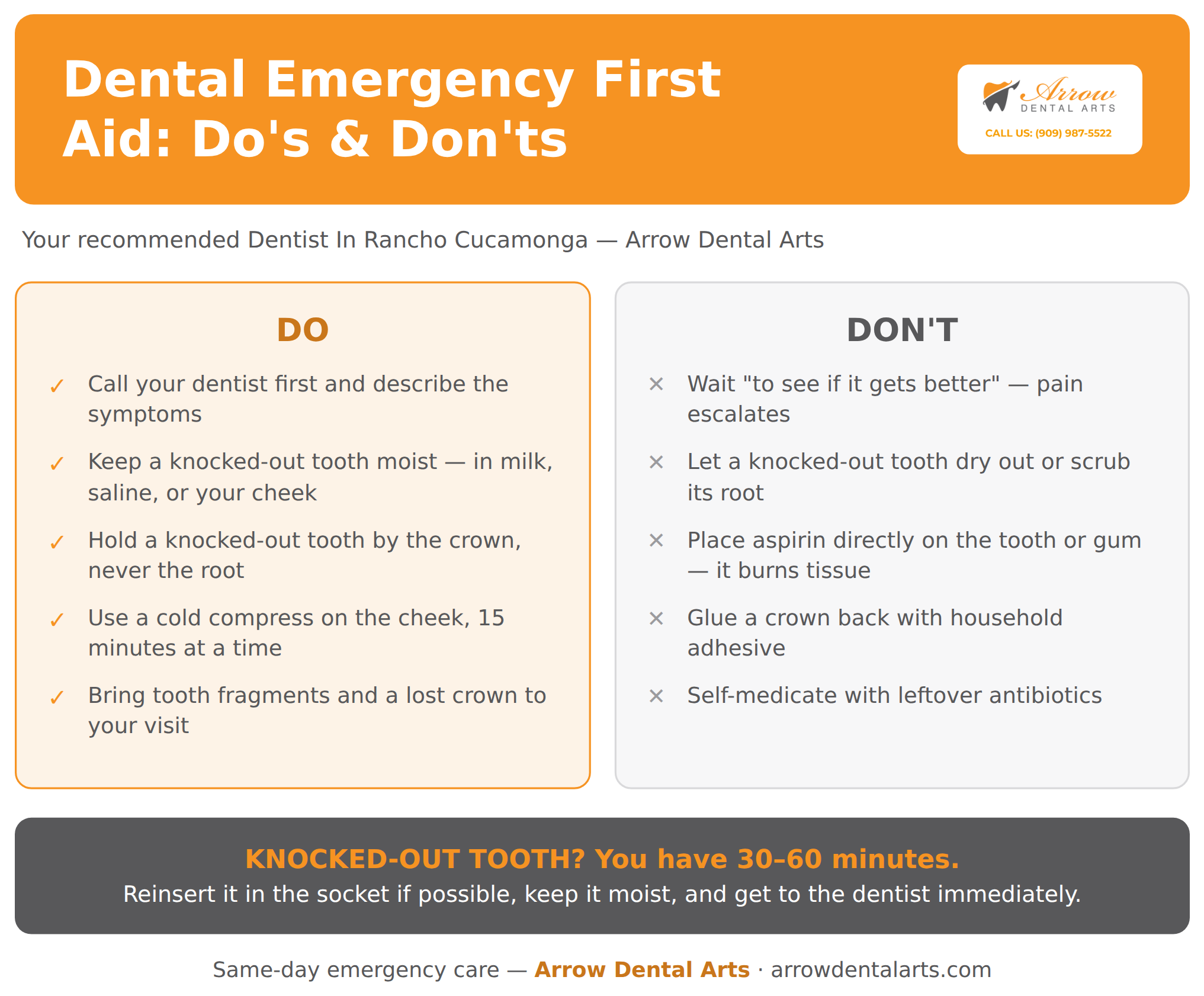
| Do | Don’t |
|---|---|
| Call your dentist first — describe symptoms, they’ll triage the urgency | Wait “to see if it gets better” — pain and infection escalate |
| Keep a knocked-out tooth moist in milk or saline | Let an avulsed tooth dry out or scrub its root |
| Use a cold compress for swelling, 15 minutes at a time | Place aspirin directly on gums or teeth (chemical burn) |
| Bring tooth fragments and your crown to the appointment | Glue a crown back with household adhesive |
| Save our number in your phone before you need it | Self-medicate with leftover antibiotics |
The best emergency is the one that never happens: twice-yearly checkups catch the weak fillings, cracks, and infections before they turn into midnight pain. When accidents do happen, families across the Inland Empire trust Arrow Dental Arts — the Dentist In Rancho Cucamonga with 200+ five-star reviews — for calm, same-day emergency care with flexible payment options.
Frequently Asked Questions
How long can a knocked-out tooth survive outside the mouth?
Roughly 30–60 minutes in milk, saline, or a tooth-preservation kit — and less if it dries out. Re-implantation success drops sharply after an hour, so head to the dentist immediately.
Is a toothache without swelling an emergency?
Pain that lasts more than a day or two, wakes you at night, or throbs without a clear cause should be seen promptly even without swelling — it often means decay or a crack has reached the nerve.
Can the ER pull a tooth?
Hospital ERs generally do not perform dental procedures; they treat pain and infection risk and refer you to a dentist. A dental office is the faster, more effective route for tooth problems.
Dental Emergency? We’re Here Today.
Call Arrow Dental Arts for same-day emergency appointments — the Dentist In Rancho Cucamonga patients trust when it can’t wait.