
The foods that damage teeth most are not always the ones that taste sweetest. Frequent sipping of soda, sports drinks, and sweetened coffee, sticky dried fruit, hard candy, and even plain crackers do more harm than a single dessert — because what erodes enamel is how often your mouth stays acidic, not just how much sugar you eat in a day.
Our dentist in Rancho Cucamonga at Arrow Dental Arts sees the pattern clearly: patients who snack or sip all day develop far more decay than patients who eat the same foods in one sitting. Below are the eight worst offenders, why each one hurts, and the swaps that actually protect teeth.
Key Takeaways
- Frequency beats quantity. Every sugar or acid exposure starts a roughly 20–30 minute acid attack on enamel, so constant sipping keeps teeth under attack all day.
- Carbonated drinks harm teeth with or without sugar, because carbonation itself is acidic.
- Sticky foods — dried fruit, gummies, crackers — cling in the grooves of molars where saliva cannot rinse them away.
- Chewing ice and hard candy causes cracks and fractures, not just wear.
- Water, plain dairy, cheese, nuts, and fibrous vegetables actively help by rinsing, buffering acid, and stimulating saliva.
Table of Contents
- Why frequency matters more than sugar
- The 8 worst foods and drinks for teeth
- Smarter swaps that protect enamel
- 5 daily habits that undo the damage
- The brushing timing mistake
- When to see a dentist
- Frequently asked questions
Why frequency matters more than sugar
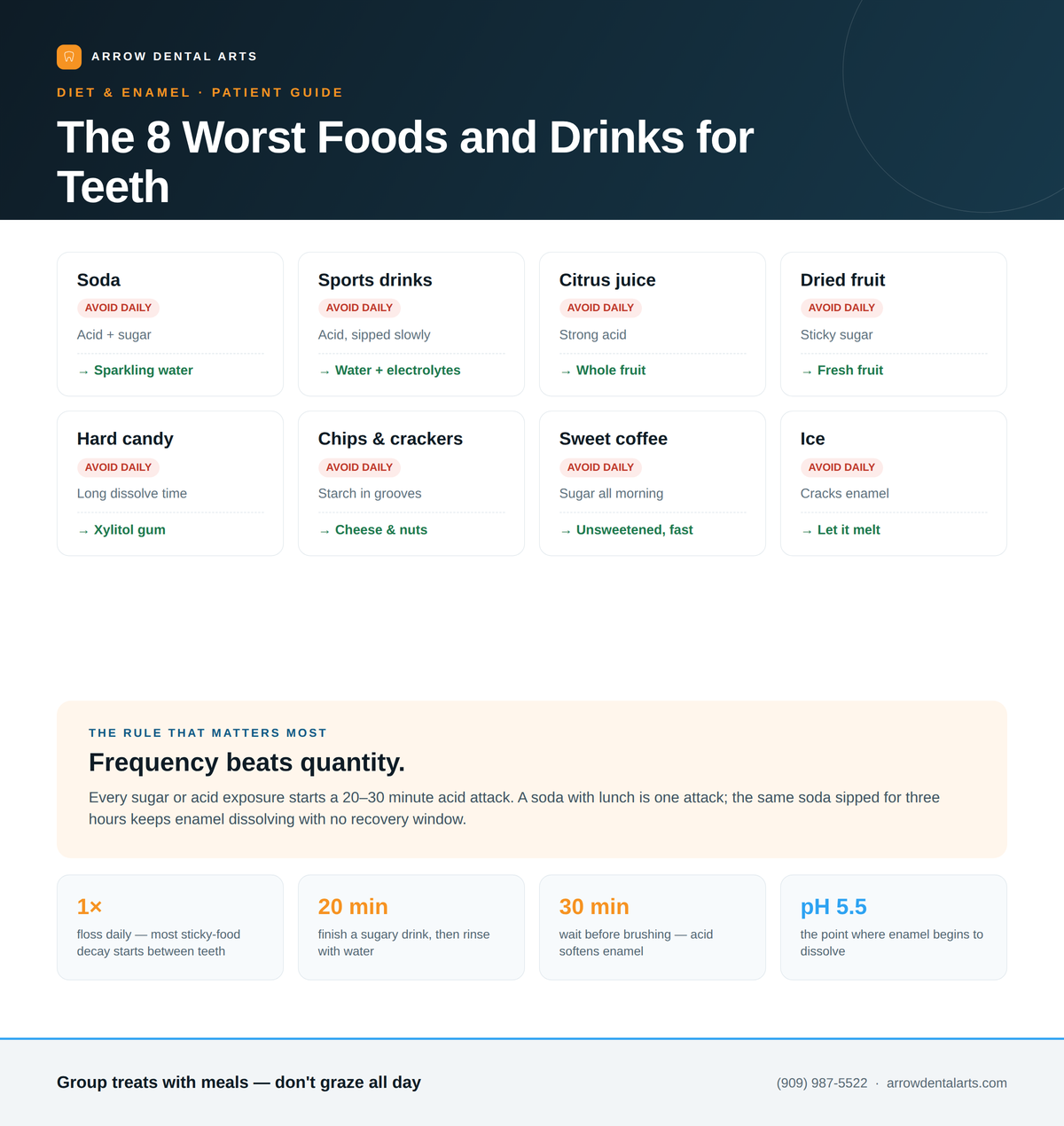
Plaque bacteria convert sugar and refined starch into acid. That acid drops the mouth’s pH below roughly 5.5, the point at which enamel begins to dissolve. Saliva then neutralizes the acid and minerals slowly return to the enamel — but that recovery takes about twenty to thirty minutes.
So a can of soda with lunch is one acid attack. The same can sipped across three hours is effectively continuous acid exposure, and enamel never gets its recovery window. This is why we tell patients that how many times a day your teeth are exposed matters more than the total sugar in the shopping cart.
The 8 worst foods and drinks for teeth
| Offender | What it does | Smarter swap |
|---|---|---|
| Soda, regular and diet | Phosphoric and citric acid erode enamel; sugar feeds decay bacteria | Sparkling water with lemon, or water with a splash of juice |
| Sports and energy drinks | High acid plus sugar; often sipped slowly over hours | Water plus electrolytes without sugar; drink fast, rinse after |
| Citrus juice | Strongly acidic, and often sipped all morning | Whole orange with water; keep juice to mealtimes with a straw |
| Dried fruit and fruit snacks | Sticky sugar that packs into grooves and stays there | Fresh fruit; rinse or brush after dried fruit |
| Hard candy and mints | Long dissolve time plus fracture risk from biting | Sugar-free xylitol gum or mints |
| Crackers, chips, and white bread | Refined starch turns to sugar and lodges between teeth | Cheese, nuts, or whole-grain crackers with the meal |
| Sweetened coffee and tea | Sugar plus pigment plus all-day sipping — stains and decay together | Unsweetened coffee or tea, finished within 20 minutes |
| Ice | No sugar, but cracks enamel and chips restorations | Chilled water, or crushed ice you let melt |
Smarter swaps that protect enamel
- Cheese and plain yogurt raise the pH in the mouth and supply calcium and phosphate for remineralization.
- Nuts and seeds scrub surfaces lightly and add protein without sugar.
- Crunchy vegetables — carrots, celery, cucumber — increase saliva flow, which is the mouth’s own buffer system.
- Water with meals rinses food debris and dilutes acid better than any beverage marketed for teeth.
- Xylitol gum after meals stimulates saliva and cannot be fermented by decay bacteria.
5 daily habits that undo the damage
- Finish drinks quickly instead of nursing them for hours, and follow with water.
- Use a straw for acidic drinks so liquid bypasses the front teeth.
- Rinse with plain water after snacks when brushing is not possible.
- Floss once a day. Most decay from sticky food starts between teeth, where a brush cannot reach.
- Chew sugar-free gum after lunch to speed up the return to a neutral pH.
The brushing timing mistake
Brushing immediately after acidic food or drink is the most common self-inflicted error we see. Acid softens the enamel surface, and brushing at that moment scrubs softened mineral away. Rinse with water, wait about thirty minutes, then brush with a fluoride toothpaste.
It is worth being equally careful about abrasive whitening trends layered on top of a high-acid diet, since that combination is what produces the thin, translucent, overly sensitive edges described in our guide to teeth that are becoming sensitive, transparent, or worn down.
When to see a dentist
Book an exam if you notice a rough or chalky patch near the gum line, a dark spot in the grooves of a molar, food that consistently catches between two teeth, sharp pain with cold or sweet foods that lingers, or a chipped edge after chewing ice or hard candy. Early erosion and early decay are both far easier — and cheaper — to manage than a tooth that has fractured.
At Arrow Dental Arts, our dentist in Rancho Cucamonga can check for erosion patterns, seal deep grooves, place fluoride varnish where enamel is thinning, and confirm whether a sensitive spot is reversible irritation or an actual cavity. Diet changes work best when they are checked against what is really happening in your mouth.
Frequently asked questions
Is diet soda really bad for teeth?
Yes — it removes sugar but keeps the acid. Phosphoric and citric acid still soften enamel, and heavy daily consumption is linked to erosion even in people with no cavities.
Does chewing ice actually damage teeth?
It can. Enamel is hard but brittle, and repeated biting on ice causes craze lines, chips, and fractured fillings.
Are dried fruits as healthy for teeth as fresh fruit?
Not for teeth. Drying concentrates sugar and creates a sticky texture that lodges in grooves. Fresh fruit carries water and fiber that help clear the mouth.
Can I reverse enamel erosion from acidic drinks?
Lost enamel does not grow back, but early softening can remineralize with fluoride, better saliva flow, and reduced acid exposure. That is the window where diet changes genuinely change the outcome.
Worried about erosion, sensitivity, or a rough spot on a tooth? Call Arrow Dental Arts at (909) 987-5522 for an exam with our dentist in Rancho Cucamonga.