
At-home whitening can gradually lift mild surface stains, while professional in-office whitening is faster, stronger, and far more predictable — but neither one can change the color of a crown, veneer, or tooth-colored filling. The right choice comes down to how deep your stains are, how sensitive your teeth already are, and whether your enamel and gums are healthy enough to whiten safely.
At Arrow Dental Arts, our dentist in Rancho Cucamonga recommends a quick shade check and exam before any whitening product touches your teeth. The most common reason whitening “doesn’t work” is not a weak product — it’s a problem whitening was never designed to fix

Key Takeaways
- Whitening removes stains; it does not change the natural color of crowns, veneers, or composite fillings, which is why mismatched front teeth are a common frustration.
- Professional whitening uses higher-concentration peroxide under supervision, so it works faster and more evenly than drugstore kits.
- Whitening toothpaste and abrasive DIY mixtures polish surface stain only — and overuse can wear enamel that never grows back.
- Short-lived sensitivity during whitening is normal and usually settles within a few days.
- Cavities, cracked teeth, receding gums, or exposed roots should be treated before whitening, not after.
Table of Contents
- How teeth whitening actually works
- At-home vs. professional whitening: side-by-side
- What at-home kits can and cannot fix
- Where DIY whitening goes wrong
- Sensitivity, fillings, crowns, and pregnancy
- How to keep whitening results longer
- When to see a dentist first
- Frequently asked questions
How teeth whitening actually works
Whitening gels contain peroxide. The peroxide passes through the porous outer layer of enamel and breaks apart the long pigment molecules trapped inside the tooth, so they reflect less color. Two actives do most of the work: hydrogen peroxide, which acts quickly, and carbamide peroxide, which breaks down into hydrogen peroxide over several hours — gentler per minute, but able to keep working while a tray is worn.
- Extrinsic stains — coffee, tea, red wine, cola, tobacco, dark sauces — sit near the surface and respond well to almost any legitimate whitening product.
At-home vs. professional whitening: side-by-side
| Factor | At-home (strips, OTC trays, toothpaste) | Professional (in-office or custom trays) |
|---|---|---|
| Peroxide strength | Lower, capped for unsupervised use | Higher, selected and monitored by a clinician |
| Time to visible change | Days to a few weeks | Often noticeable after a single visit |
| Fit and coverage | One-size strips or boil-and-bite trays; gel can pool on gums | Custom-scanned trays or a painted barrier that protects gums |
| Evenness | Can be patchy on curved or crowded teeth | More uniform, and checked against a shade guide |
| Sensitivity risk | Lower per session, higher if used too often | Higher per session, managed with desensitizers |
| Best suited for | Mild staining, maintenance, budget-conscious patients | Deeper stains, an event deadline, uneven shading, previous failures |
What at-home kits can and cannot fix
Whitening strips work well on the broad front surfaces of incisors and canines, but they are a fixed shape. On crowded teeth or curved premolars, the strip wrinkles and leaves the contact points untouched, which can read as uneven color.
Over-the-counter trays are the most common source of gum irritation. A tray that does not seal lets gel sit against the gum line for the full wear time, and that is where chemical burns and a temporary white rim along the gums come from.
Whitening toothpaste deserves a reality check. It contains mild abrasives and sometimes a blue optical brightener that makes teeth look whiter by shifting the way light reflects. It removes surface stain. It cannot lighten the tooth itself, and scrubbing harder only removes more enamel.
Where DIY whitening goes wrong
Three habits cause most of the damage we see:
- Acid plus abrasive. Lemon juice, vinegar, or apple-cider-vinegar rinses soften enamel, then brushing or baking soda scrubs that softened layer away. The result is thinner enamel and permanently more yellow-looking teeth, because dentin is showing through.
- Endless repeat cycles. Using strips or trays far beyond the label, or running “maintenance” whitening every week, keeps the nerve irritated and can leave chalky, translucent edges.
- Whitening over untreated decay or gum disease. Peroxide on an open cavity or an inflamed gum line produces sharp pain and no cosmetic benefit.
Enamel does not regenerate. Anything that removes it is a one-way trade, which is why “how strong can I go” is the wrong question and “what is safe for my enamel” is the right one. It is also why we check for the warning signs of enamel wear before starting.
Sensitivity, fillings, crowns, and pregnancy
Sensitivity is the most common side effect and is usually transient — a day or two of cool-air and cold-drink twinges.
Restorations do not whiten. Crowns, veneers, bonding, and white fillings keep their original shade while the surrounding enamel lightens, and a single front filling can end up looking distinctly darker. The fix is usually to whiten first, then replace the visible filling to match — a sequencing decision worth making with your dentist rather than after the fact.
How to keep whitening results longer
- Use a straw for iced coffee and dark sodas to keep liquid away from the front teeth.
When to see a dentist before whitening
Book an exam first if you have any of the following: a sensitive or aching tooth, visible cavities or dark spots, gums that bleed or have receded, a chipped or cracked tooth, front teeth with existing fillings, bonding, or crowns, one tooth that is noticeably darker than its neighbors, or a history of heavy whitening over the years.
At Arrow Dental Arts, our dentist in Rancho Cucamonga will confirm your enamel and gums are healthy, identify which stains are likely to respond, and match the method to your sensitivity — in-office for speed, custom trays for gradual and controlled lightening, or a combination. If you have been whitening for weeks with no change, that is a diagnosis question, not a product question.
Frequently asked questions
Is professional whitening actually better than at-home strips?
It is stronger, faster, and more evenly applied, and it comes with an exam that catches decay or gum problems first.
Can whitening damage my enamel?
Peroxide whitening used correctly does not strip enamel. Damage usually comes from abrasive DIY remedies, over-frequent cycles, or whitening over untreated decay and receding gums. That is why supervision matters more than the product itself.
How long do results last?
Typically several months to a couple of years, depending on diet, smoking, and home care. Coffee, tea, red wine, and tobacco shorten it noticeably.
Why did only one of my teeth whiten?
A single dark tooth is often an older injury, a dying nerve, a deep filling, or a stain locked inside the tooth. Whitening alone rarely fixes it, and it should be examined — sometimes the answer is a root canal and internal whitening, sometimes a restoration.

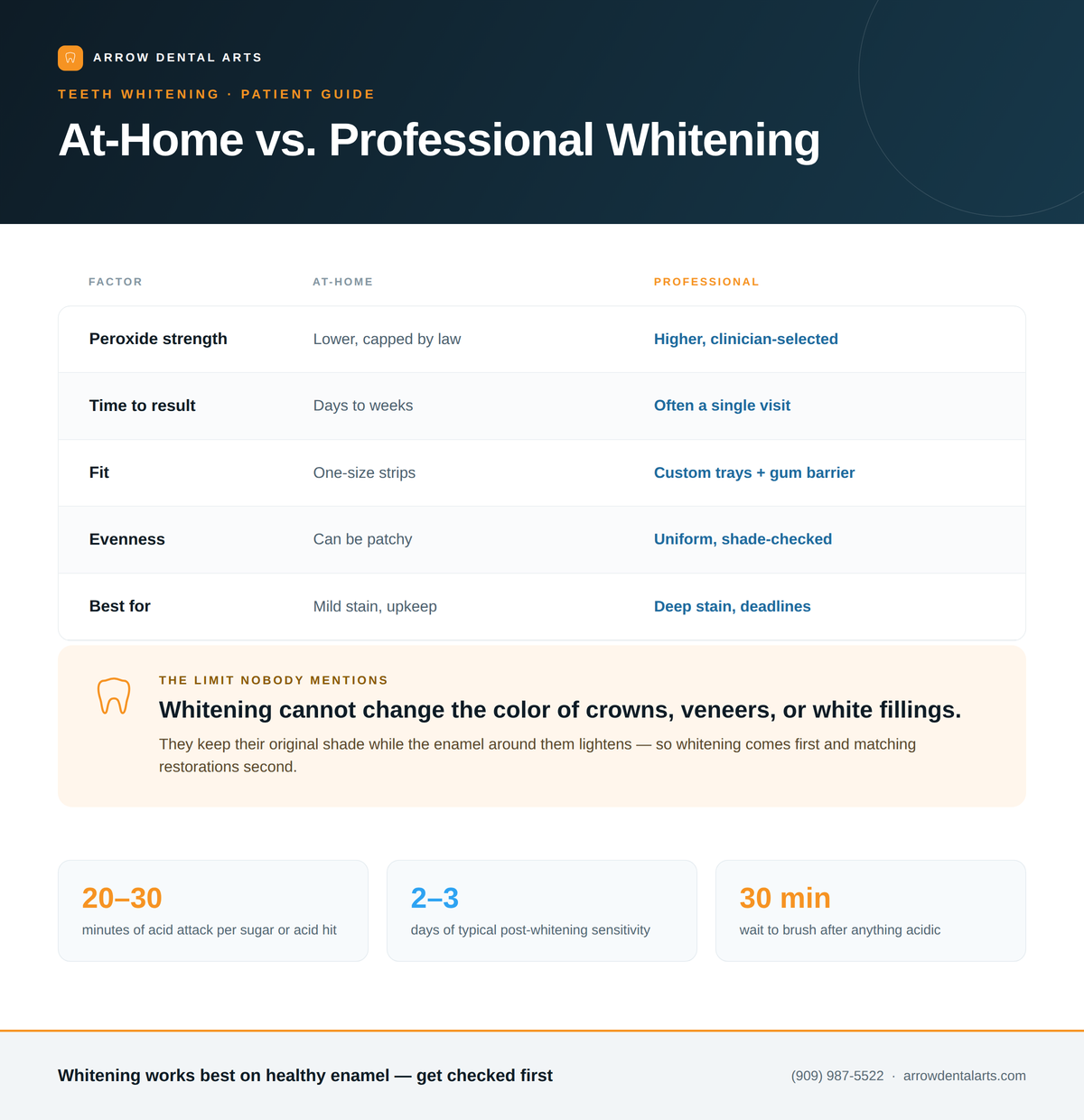
Teeth Whitening Comparison Infographic — Arrow Dental Arts, dentist in Rancho Cucamonga
Wondering which whitening option fits your teeth? Call Arrow Dental Arts at (909) 987-5522 to schedule an exam and shade assessment with our dentist in Rancho Cucamonga.