

@media(min-width:981px){.et_right_sidebar #left-area{width:100%!important;float:none!important;padding-right:0!important}.et_right_sidebar #sidebar{display:none!important}.et_right_sidebar .container:before{display:none!important}.et_right_sidebar #main-content .container:before{display:none!important}}
Key Takeaways
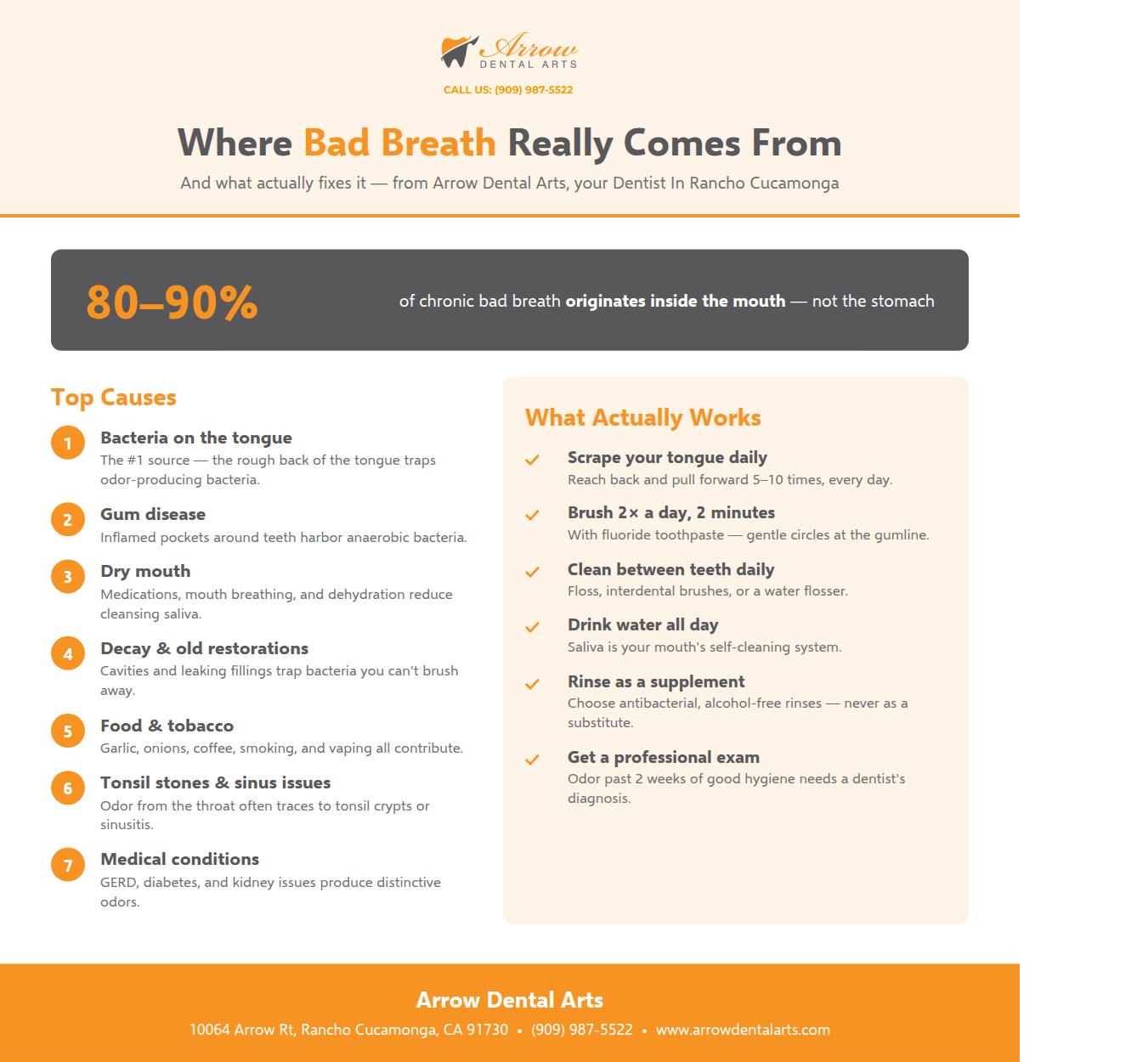
- About 80–90% of bad breath originates inside the mouth — not the stomach — most often from bacteria on the tongue, gum disease, or dry mouth.
- Mouthwash only masks odor for 15–30 minutes; it does not remove the bacterial film (biofilm) that actually produces the smell.
- Cleaning your tongue daily, staying hydrated, and treating gum inflammation fix most cases of chronic bad breath within a few weeks.
- Persistent bad breath despite good hygiene can signal gum disease, untreated cavities, tonsil stones, sinus problems, or conditions like GERD and diabetes.
- Arrow Dental Arts — the Dentist In Rancho Cucamonga patients trust for honest answers — can pinpoint the exact cause of bad breath in a single diagnostic visit.
Chronic bad breath is embarrassing, but it is also one of the most treatable dental problems there is. The first step is understanding where the odor actually comes from — and the answer surprises most people. If you have been chewing mints all day, blaming your stomach, or avoiding close conversations, this guide from the Dentist In Rancho Cucamonga team at Arrow Dental Arts explains the real causes of halitosis, why mouthwash alone never fixes it, and what actually works.
Table of Contents
What Causes Bad Breath?
Bad breath — dentists call it halitosis — is caused in roughly 80–90% of cases by bacteria living inside the mouth. These bacteria break down proteins from food debris, plaque and dead cells, releasing volatile sulfur compounds: the same chemistry behind rotten-egg odor. Only a small minority of cases start elsewhere in the body, which is why the fix almost always begins in the mouth, not the stomach. As the Dentist In Rancho Cucamonga patients hear from us every day: if your breath is chronically bad, the source is almost certainly your tongue, your gums, or a dry mouth — and all three are fixable.
Why Mouthwash Alone Doesn’t Fix Bad Breath
Most mouthwashes are perfume, not medicine. A cosmetic rinse kills a few surface bacteria and then coats your mouth with a mint scent that fades within 15–30 minutes — while the bacterial film on your tongue and along your gumline keeps producing sulfur compounds underneath it. Even antibacterial rinses cannot fully penetrate a thick tongue coating or the pockets around inflamed gums. Mouthwash has a role in a complete routine, but treating it as the solution is the single most common mistake we see. The odor returns every time because the source was never removed.
The 7 Most Common Causes, Ranked
- Bacteria on the tongue. The back of the tongue is the #1 source of bad breath. Its rough, papilla-covered surface traps bacteria and food particles in a coating most people never brush.
- Gum disease. Gingivitis and periodontitis create inflamed pockets around the teeth where anaerobic bacteria thrive — producing a distinctive, persistent odor that no mint can cover.
- Dry mouth (xerostomia). Saliva is your mouth’s self-cleaning system. Medications, mouth breathing, CPAP use, and dehydration all reduce saliva flow and let odor-producing bacteria multiply overnight.
- Tooth decay and faulty restorations. Cavities, leaking fillings, and food traps under old crowns harbor bacteria you cannot reach with a toothbrush.
- Food and lifestyle. Garlic, onions, coffee, smoking, and vaping all contribute — tobacco also dries the mouth and damages gums, doubling the effect.
- Tonsil stones and sinus issues. Odor from the back of the throat — especially with post-nasal drip — often traces to tonsil crypts or chronic sinusitis rather than the teeth.
- Medical conditions. GERD, diabetes (a fruity or acetone odor), kidney disease, and certain medications can all produce distinctive breath odors that warrant a physician’s involvement.
How To Get Rid of Bad Breath: What Actually Works
Here is the routine we recommend to our Rancho Cucamonga patients — most notice a real difference within one to two weeks:
- Clean your tongue every day. Use a dedicated tongue scraper (or your toothbrush) and reach as far back as is comfortable, scraping forward 5–10 times. This alone eliminates the odor source for many people.
- Brush twice daily with fluoride toothpaste — two full minutes. Rushed brushing leaves the bacterial plaque that feeds odor-producing bacteria.
- Clean between your teeth once a day. Floss, interdental brushes, or a water flosser remove the trapped debris that rots between teeth — the debris your toothbrush cannot reach.
- Drink water throughout the day. Fluishing saliva flow washes away bacteria constantly. If your mouth is dry, ask about moisturizing rinses or a saliva stimulant.
- Use an antibacterial mouth rinse as a supplement, not a substitute. Choose one with cetylpyridinium chloride or chlorine dioxide; avoid alcohol-based rinses that dry the mouth.
- Chew sugar-free gum with xylitol after meals when you cannot brush — it stimulates saliva and physically clears food particles.
- Get a professional cleaning and exam. If odor persists after two weeks of diligent home care, the cause is almost certainly below the gumline or inside a tooth, and no home remedy will reach it.
When To See a Dentist About Bad Breath
Make an appointment if bad breath lasts longer than two weeks despite good hygiene, if you notice bleeding gums, loose teeth, or a persistent bad taste, or if the odor is strong enough that others comment on it. At Arrow Dental Arts we track the source systematically: we examine the tongue and gums, check for decay and failing restorations, measure gum pockets, and — when the mouth checks out — point you toward the sinus, tonsil, or medical causes worth exploring with your physician. Patients are often relieved to learn the fix was as simple as gum treatment or a tongue-scraping habit.

Frequently Asked Questions
Is bad breath coming from my stomach?
Rarely. The overwhelming majority of bad breath originates in the mouth — bacteria on the tongue, gum disease, decay, or dry mouth. Stomach-related odor usually only appears with conditions like GERD, and even then the mouth contributes.
How can I tell if my own breath smells bad?
You cannot reliably smell your own breath — you are habituated to it. Lick your wrist, let it dry for 10 seconds, and sniff, or ask a trusted person. The most accurate check is a dentist’s assessment.
Do probiotics or mints cure bad breath?
There is limited evidence for probiotics. Mints only mask odor — and sugary mints feed the very bacteria that cause the smell. Sugar-free versions with xylitol are the better choice.
Can gum disease cause bad breath even if my breath is fine in the morning?
Gum-related odor typically worsens throughout the day and after meals. If your breath is consistently worse in the evening or after eating, gum disease and trapped food debris are the more likely culprits.
Ready To Find the Real Cause of Your Bad Breath?
Arrow Dental Arts diagnoses halitosis in a single visit — tongue, gums, decay, and dry mouth all checked — with same-day appointments available.
Book your evaluation today or call (909) 987-5522.