
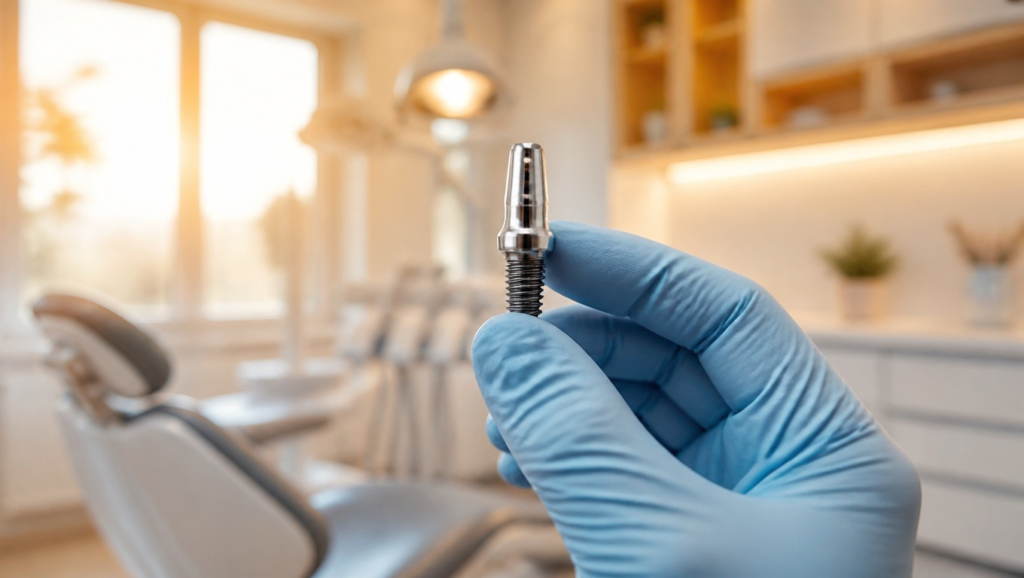
A dental implant is the only tooth replacement that rebuilds the entire tooth, root included. A titanium post is set into the jawbone, the bone grows onto it over three to six months, and a custom crown is attached on top. Most healthy adults are candidates, and most cases finish in four to eight months from surgery to final crown. The two things that decide your timeline and your fee are bone volume and how well you heal.
Key takeaways
- Root-level replacement: an implant does not touch or support the neighboring teeth, unlike a bridge.
- Bone can be rebuilt: a graft or sinus lift can make implant placement possible when the jaw has resorbed.
- Long-term data is strong: a systematic review of contemporary implant systems reported 96.4% ten-year survival at the implant level.

What a dental implant actually is
An implant is not a tooth. It is a three-part system that together behaves like one:
- The fixture – a threaded titanium post that takes the place of the root and bonds with living bone.
- The abutment – the connector that sits above the gumline and holds the restoration.
- The crown – the visible tooth, shaped and shaded to match its neighbors.
Are you a candidate? The five factors we check
Candidacy is a measurement question, not an age question. At Arrow Dental Arts we evaluate:
- Bone volume and density. After extraction, the jaw narrows and drops. A cone-beam scan tells us whether there is enough bone for a stable implant or whether grafting is needed first.
- Gum health. Active periodontal disease must be treated and stabilized before surgery; inflammation interferes with healing.
- Medical history. Uncontrolled diabetes, certain autoimmune conditions and medications such as bisphosphonates change the plan and sometimes the recommendation.
- Smoking. Nicotine narrows blood vessels and slows the bone response. Quitting before surgery measurably improves the odds.
- Bite and parafunction. Heavy clenching or grinding loads an implant differently than a natural tooth, so protection may be part of your plan.
Age itself is rarely the deciding factor. The 2019 review cited below found survival still above 91% at ten years in patients 65 and older, which is a reason to plan carefully — not a reason to rule implants out.
The implant timeline, stage by stage
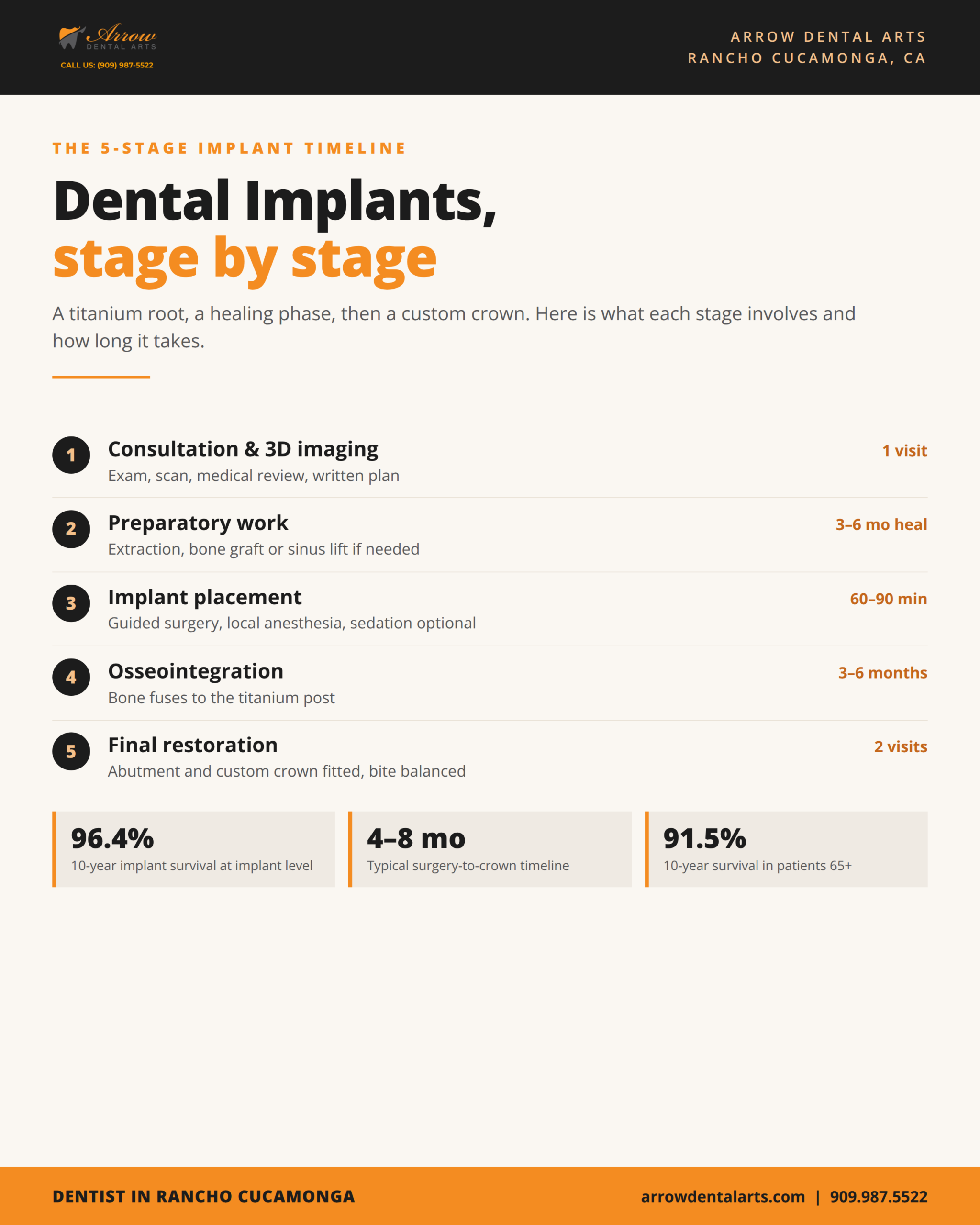
Every case is different, but the sequence is predictable. Use this as a planning guide, not a promise.
| Stage | What happens | Typical timing |
|---|---|---|
| 1. Consultation and imaging | Exam, 3D scan, medical review, written treatment plan | 1 visit |
| 2. Preparatory work | Extraction, bone graft or sinus lift if required | Healing of 3–6 months before implant placement |
| 3. Implant placement | Post is positioned with guided surgery under local anesthesia, with sedation available | 60–90 minutes |
| 4. Osseointegration | Bone fuses to the implant surface; a temporary tooth can often be worn | 3–6 months |
| 5. Restoration | Abutment and custom crown are fitted and the bite is adjusted | 2 visits |
| 6. Maintenance | Hygiene visits and bite checks | Every 6 months |
What drives the cost of dental implants
There is no single implant price, because there is no single implant case. These are the variables that move a fee up or down, and the ones worth asking about when you compare estimates:
| Cost factor | Why it changes the fee |
|---|---|
| Number of implants | One tooth, several teeth or a full arch each carry different surgical and lab work. |
| Bone grafting or sinus lift | Adds a procedure and a healing interval before the implant itself. |
| Extraction | Sometimes simple, sometimes surgical, sometimes with socket preservation. |
| Crown material | Zirconia, layered ceramic and metal-ceramic differ in lab cost and esthetics. |
| Imaging and guided surgery | 3D planning improves placement accuracy in complex anatomy. |
Ask for a written plan that separates surgical, prosthetic and lab fees, and ask what happens if a graft is needed later. At Arrow Dental Arts we are preferred providers for major dental insurance plans, and for patients without insurance we build payment plans that can run as long as 60 months, so a necessary implant does not have to be delayed for budget reasons.
Implant vs. bridge vs. denture
| Implant + crown | Fixed bridge | Removable denture | |
|---|---|---|---|
| Neighboring teeth | Untouched | Two teeth must be reduced | Untouched |
| Bone support | Stimulates bone | No stimulation at the gap | No stimulation |
| Cleaning | Brush and floss normally | Threaders or water flosser under the span | Removed and soaked daily |
| Feel and bite force | Closest to a natural tooth | Good | Reduced, movement possible |
| Upfront cost | Highest | Moderate | Lowest |
| Typical lifespan | Decades with care | 10–15 years | 5–8 years, with relines |
How long implants really last
The most cited contemporary figure comes from a 2019 systematic review and meta-analysis in the Journal of Dentistry, which pooled 18 studies of modern screw-type, roughened-surface implants. Ten-year survival at the implant level was 96.4% (95% CI 95.2–97.5). The authors’ more conservative sensitivity analysis, which accounted for patients lost to follow-up, estimated 93.2%, with a lower figure of about 91.5% for patients aged 65 and older.
Translation for patients: implants are highly predictable, but they are not maintenance-free. The failures that do occur cluster around smoking, uncontrolled diabetes, poor plaque control, untreated grinding and skipped hygiene visits — all things a patient can influence.
Aftercare that protects your investment
- Keep the implant clean like a tooth, not like hardware. Floss or use interdental brushes daily; peri-implant inflammation starts silently.
- Wear the night guard if one was made. Grinding is the most common cause of mechanical complications in otherwise healthy implants.
Frequently asked questions
How soon can I have a tooth on the implant?
Sometimes a temporary crown is placed the same day for esthetics, but it is kept out of the bite. The final crown waits until the bone has fused, typically three to six months.
Can I get an implant if I have low bone?
Usually yes. Socket preservation at the time of extraction, a bone graft, or a sinus lift can rebuild enough volume. The graft adds a healing interval, not a permanent disqualification.
What if I have gum disease?
Active periodontitis is treated and stabilized first. Placing an implant into uncontrolled inflammation lowers the odds of success, which is why a periodontal evaluation is part of the workup at Arrow Dental Arts.
Not sure whether an implant is the right call?
Arrow Dental Arts offers comprehensive exams with 3D imaging, a written plan and a clear explanation of every option — including the ones that cost less. If you have been told you are “not a candidate,” a second opinion with a periodontist is worth the visit.
Reviewed by Adrian Mobilia, DDS — periodontist, Associate Professor of Periodontics at Loma Linda University, and co-founder of Arrow Dental Arts in Rancho Cucamonga.
Source: Howe MS, Keys W, Richards D. Long-term (10-year) dental implant survival: a systematic review and sensitivity meta-analysis. J Dent. 2019;84:9–21. PubMed 30904559