
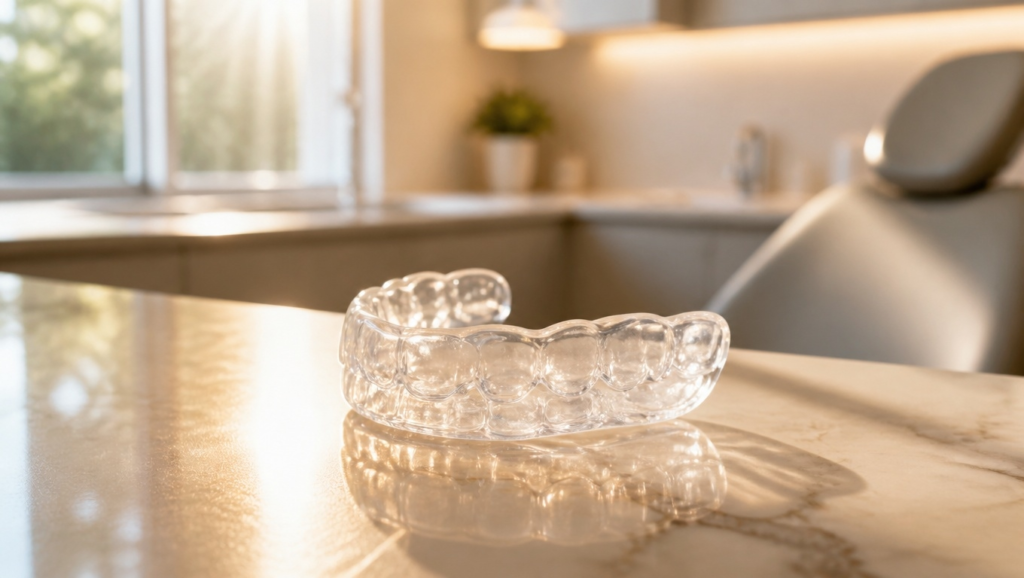
Sleep bruxism is the unconscious clenching or grinding of teeth during sleep, and it is far more common than most people realize: roughly 8% of middle-aged adults grind regularly, and most of them do not know they do it. The damage shows up years before the symptoms do — flattened enamel, hairline cracks, receding gums and jaw joints that ache by mid-afternoon. The fix is not willpower. It is diagnosis, protection at night, and removing the triggers that keep the habit alive.
Key takeaways
- Bruxism is a sleep-related behavior, not a nervous habit you can simply decide to stop.
- Morning clues count most: jaw soreness, temple headaches and teeth that feel “loose” on waking point to night grinding.
- Enamel does not grow back. Once wear exposes dentin, sensitivity and decay risk rise permanently.
- A custom guard protects; an OTC guard often does not fit well enough to be worn every night.
- Grinding and sleep apnea overlap, so airway symptoms deserve a look before treatment is finalized.

What bruxism actually is
Bruxism has two forms. Awake bruxism is daytime clenching, often while concentrating or driving. Sleep bruxism is rhythmic grinding during sleep, and it is the more destructive of the two because the forces are far higher and nobody is there to stop them.
During sleep, the protective reflexes that normally keep your bite gentle are largely offline. Clenching forces can exceed those of normal chewing several times over, repeated in bursts through the night. That is why a night of grinding can do more enamel damage than a day of chewing steak.
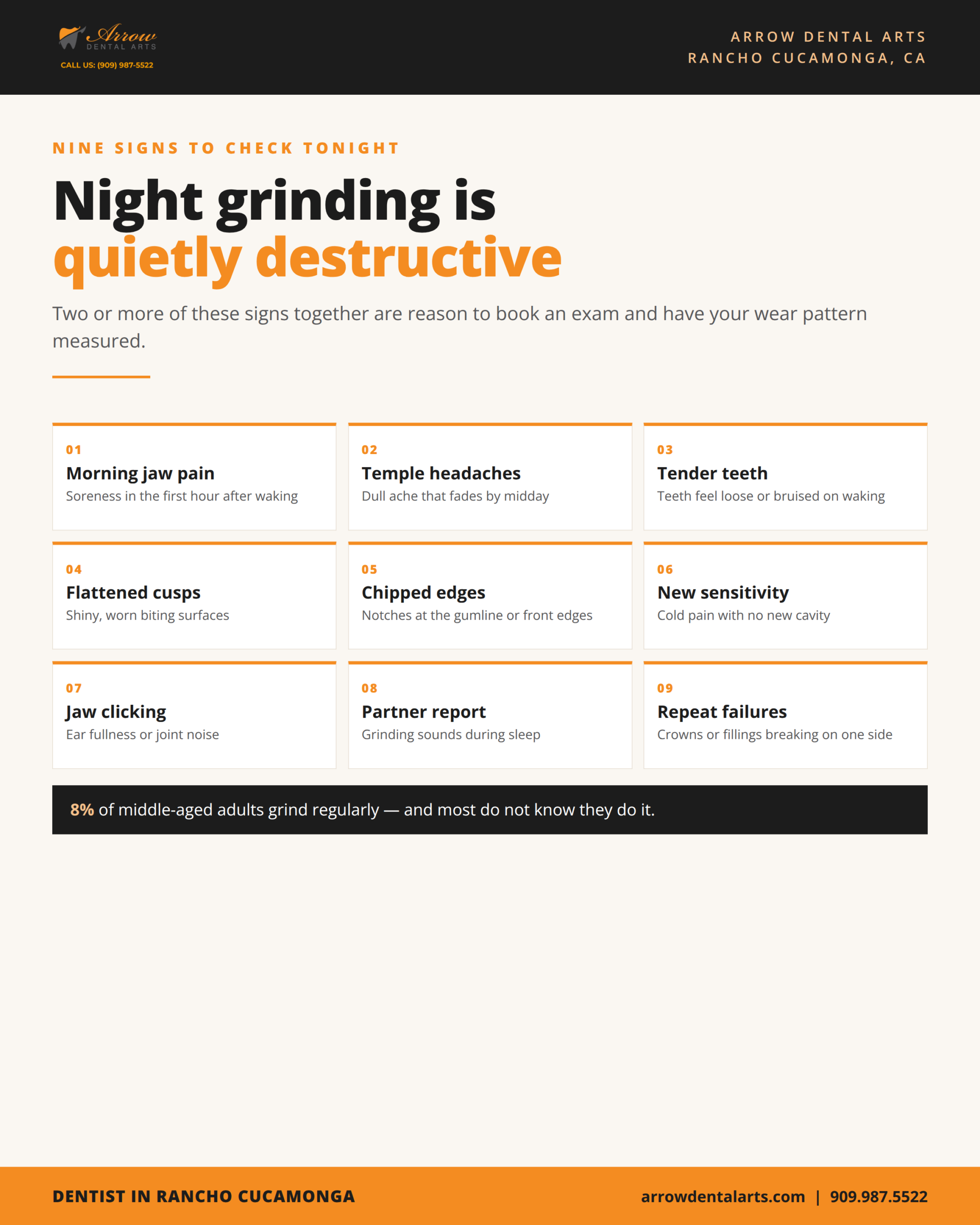
Nine signs you may be grinding
Grinding is usually diagnosed by its evidence, not by catching yourself in the act. Common findings:
- Jaw, cheek or temple soreness in the first hour after waking.
- Dull headaches that start in the morning and fade by noon.
- Teeth that feel tender or slightly mobile on waking.
- Flattened, shiny cusps or a bite that suddenly feels “even.”
- Chipped edges on front teeth, or notches at the gumline.
- Increased cold sensitivity without a new cavity.
- Ear fullness or clicking in the jaw joint.
- A partner who reports grinding sounds at night.
- Crowns, fillings or veneers that keep failing on one side.
Two or more of these together are enough reason to book an exam. A Dentist In Rancho Cucamonga can usually confirm wear patterns in a single visit and document them with photos so future changes are measurable.
What grinding does to teeth and gums
| Structure | What happens | What patients notice |
|---|---|---|
| Enamel | Microfractures and progressive wear | Flatter teeth, darker tips, visible dentin |
| Dentin | Exposed tubules once enamel is gone | Sharp pain with cold or sweets |
| Gums | Wedges and recession at the neck of the tooth | Longer-looking teeth, root sensitivity |
| Restorations | Fractured margins, chipped ceramic | Repeated repairs on the same teeth |
| Jaw joint | Capsule irritation and disc strain | Clicking, limited opening, facial ache |
| Muscles | Hypertrophy from nightly overuse | Squared jaw, morning stiffness |
One more cost is invisible: wear happens on a curve. Losing the first millimeter of enamel takes years; losing the second takes much less time, because dentin wears faster than enamel does. That is the argument for intervening early rather than “watching it.”
Night guards: custom vs. over-the-counter
| Custom lab guard | Boil-and-bite guard | No protection | |
|---|---|---|---|
| Fit | Scanned to your teeth | Approximate, loosens over time | – |
| Bite balance | Designed to distribute load evenly | Usually flat, can worsen clenching | – |
| Comfort | Thin, worn consistently | Bulky; many patients stop using it | – |
| Enamel protection | Yes, plus a seat for future restorations | Partial | No |
| Lifespan | 3–5 years typical | Months | – |
A guard does not stop grinding. It intercepts the force so the enamel, gums and restorations absorb less of it. Patients who expect the habit to disappear are often disappointed; patients who expect their teeth to stop wearing are usually pleased.
Why it happens, and what you can change
Sleep bruxism is driven by the central nervous system, which is why “just relax” does not work. But several inputs turn the volume up:
- Stress and poor sleep quality — the strongest everyday amplifiers.
- Alcohol in the evening — relaxes the airway and fragments sleep, increasing grinding episodes.
- Late caffeine and nicotine — both are stimulants with a long tail.
- Bite interference — a high filling or a shifted tooth can trigger a guarding response.
Small, unglamorous changes do help: a consistent sleep schedule, cutting alcohol close to bedtime, and a brief jaw-muscle stretch and “lips together, teeth apart” reset during the day.
The sleep apnea connection
Grinding often travels with airway problems. When breathing is obstructed, the body surges and the jaw muscles fire — grinding can be part of that arousal. Treating the airway sometimes reduces the grinding itself.
Ask yourself: do you snore, wake unrefreshed, or feel sleepy in the afternoon? If yes, mention it at your dental visit. Arrow Dental Arts evaluates snoring and obstructive sleep apnea and can coordinate care, because the right appliance depends on which problem is driving the other.
A practical plan for the next 30 days
- Get a baseline exam with photos and a bite assessment, so wear is measured rather than guessed.
- Get fitted for a custom guard if wear or symptoms are present — and actually wear it.
- Cut evening alcohol and caffeine for two weeks and note the difference in morning symptoms.
- Treat the sensitivity with desensitizing toothpaste while the cause is addressed.
- Screen for airway issues if snoring or daytime fatigue is part of the picture.
Frequently asked questions
Can teeth grinding fix itself?
It can become less frequent with age, but existing wear does not reverse. Protection is about preventing the next few years of damage, not waiting for the habit to end.
Will a night guard stop my headaches?
Many patients report fewer morning headaches because the jaw muscles work less against a balanced surface.
Can kids grind their teeth?
Yes, and it is common in children with primary teeth. It usually resolves as the bite matures; a pediatric exam is warranted if there is pain, wear or chipped teeth.
What if my jaw locks?
Locking, severe pain or inability to open fully needs prompt evaluation. Call the office rather than waiting for a routine cleaning.
Waking up with a sore jaw?
A 30-minute exam at Arrow Dental Arts can confirm whether your enamel is wearing and fit you with a guard that is comfortable enough to wear every night. Same-day emergency care is available when pain cannot wait.
Reviewed by Andrea J. Mobilia, DDS — co-founder of Arrow Dental Arts in Rancho Cucamonga, with advanced training in general and cosmetic dentistry.
Sources: Zieliński G, et al. Global prevalence of sleep bruxism and awake bruxism in pediatric and adult populations: a systematic review and meta-analysis (2024); Khoury S, et al. Sleep bruxism-tooth grinding prevalence, characteristics and familial aggregation. Sleep (2016).