
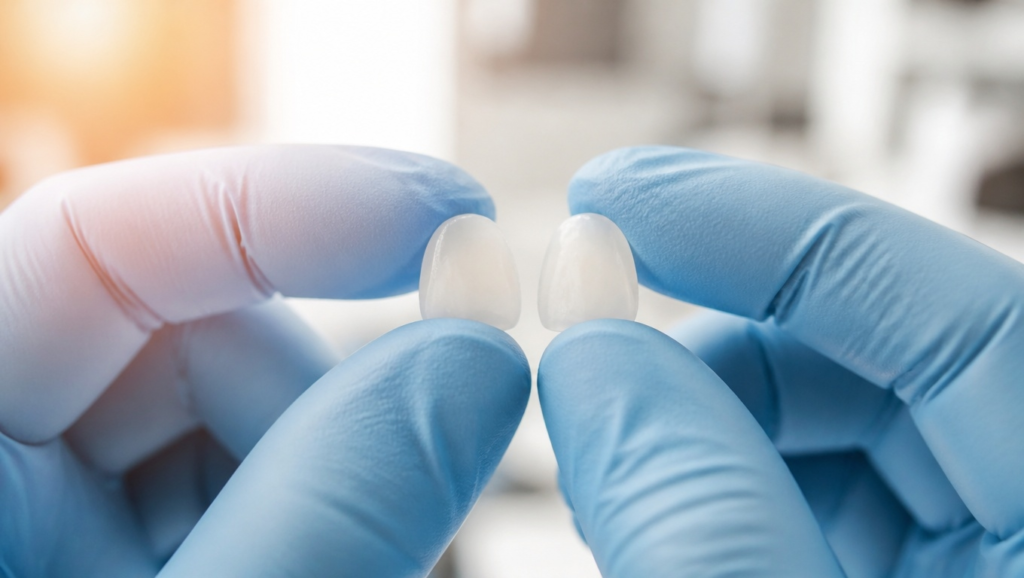
Whitening and veneers are often discussed as if they were two versions of the same treatment. They are not. Whitening changes the color of your natural teeth; veneers change the shape, size and shade by covering the front surface. If your teeth are healthy and simply stained, whitening is the conservative answer. If they are chipped, worn, rotated or unevenly spaced, no amount of bleaching will correct the shape — and that is where veneers earn their place.
Key takeaways
- Different jobs: whitening is a chemistry treatment; veneers are a structural and esthetic restoration.
- Whitening only works on natural tooth structure — crowns, veneers and composite will not lighten.
- Veneers are irreversible because a thin layer of enamel is prepared, so the decision deserves more caution.
- Extrinsic stains respond fastest to cleaning and bleaching; intrinsic stains take longer and sometimes respond partially.
- Doing both is common — whiten first, then match veneers to the new shade.

The core difference in one minute
Whitening uses a peroxide gel to oxidize the colored compounds trapped inside enamel and dentin. The tooth keeps its own shape; only its shade changes. Veneers are thin shells of ceramic bonded to the front of the teeth — the tooth gains a new surface, and that surface can be shaped to change length, width, symmetry and color all at once.
Put simply: whitening adjusts brightness. Veneers redesign the tooth. Choosing between them is a question of what is actually wrong, not which one sounds more premium.
What teeth whitening can and cannot fix
The American Dental Association separates discoloration into extrinsic stains, which sit on the surface, and intrinsic stains, which sit inside the tooth. Extrinsic stains come from coffee, tea, red wine, tobacco and pigmented foods; a professional cleaning plus whitening handles most of them. Intrinsic staining has deeper causes: aging (thinner enamel letting yellow dentin show through), fluorosis, tetracycline use in childhood, trauma, and old restorations.
What whitening does well:
- Lifts surface and mild internal staining across all visible teeth at once.
- Is repeatable, so it fits a maintenance mindset.
What it cannot do:
- Change the color of crowns, veneers, bonding or implants.
- Straighten, lengthen or reshape a tooth.
- Close a gap or repair a chip.
Two safety notes worth knowing. Whitening is safe and effective when manufacturer instructions are followed, but it should start with an exam, because bleaching an untreated cavity or inflamed gum tissue causes pain rather than a brighter smile. And in-office treatment typically lightens more in one visit than store-bought strips, with a dentist controlling the gel strength and gum protection.
What veneers can and cannot fix
Veneers are the right tool when the problem is geometry or structural. Candidates usually have one or more of these:
- Chipped, cracked or worn front teeth.
- Persistent discoloration that bleaching did not resolve, especially on a single tooth.
- Small gaps, minor crowding or rotated teeth where orthodontics is not wanted.
- Short or uneven teeth that make the smile line look unbalanced.
- Old, failing bonding or anterior crowns that need replacement anyway.
What veneers cannot do: they do not straighten a badly misaligned bite, they do not fix gum disease, and they do not replace missing teeth. They also commit you to a maintenance cycle, because ceramic can chip and the underlying tooth can still decay at the margins if hygiene slips.
The irreversible part deserves plain language. Preparing a tooth for a veneer removes a small but permanent amount of enamel. Once that is done, the tooth needs a restoration for life.
Side-by-side comparison
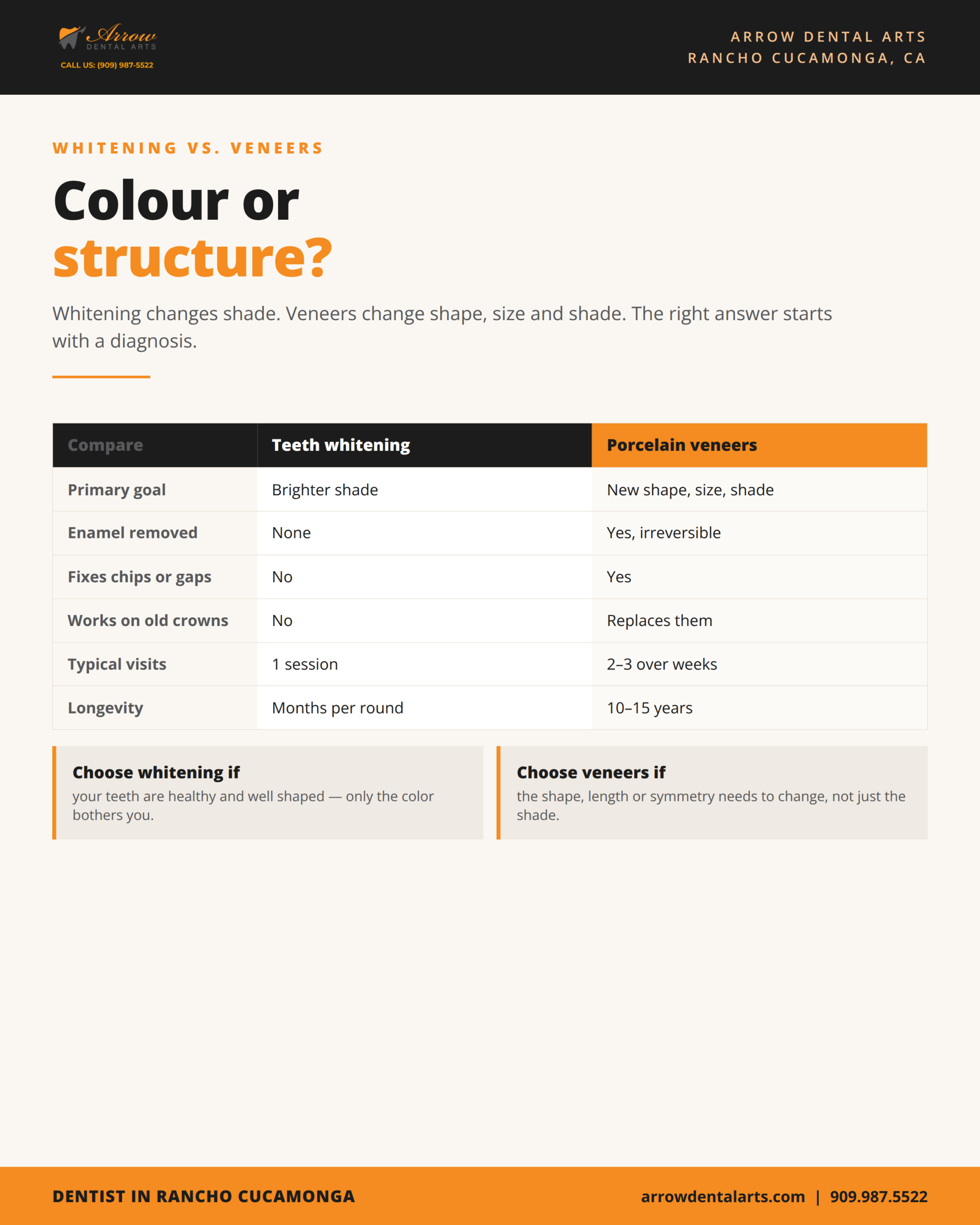
| Professional whitening | Porcelain veneers | |
|---|---|---|
| Primary goal | Brighter shade | New shape, size and shade |
| Tooth structure removed | None | Yes, a thin layer of enamel |
| Reversible | Yes | No |
| Typical visits | 1 in-office session, or trays at home | 2–3 visits over a few weeks |
| Works on crowns or bonding | No | Replaces them if needed |
| Fixes chips or gaps | No | Yes |
| Longevity | Months to a few years per round | 10–15 years with care |
| Maintenance | Touch-ups, stain control | Hygiene, night guard, avoid biting hard objects |
| Best for | Healthy, well-shaped, stained teeth | Healthy teeth with shape or color defects |
Read the last row first. If your teeth are the right shape and only the color bothers you, whitening delivers most of the benefit at a fraction of the commitment.
Which one fits your situation?
Use these short profiles as a starting point, then confirm with an exam and photos.
- Stained but well-aligned teeth: whitening, plus a cleaning to remove surface stain first.
- Chipped edges and uneven lengths: veneers, or conservative bonding if the budget or the enamel is limited.
- Gaps between front teeth: orthodontics, bonding or veneers — the choice depends on the bite, not preference alone.
- Heavy wear from grinding: protect first, restore second. Veneers placed on an unprotected grinding habit fail.
- Active gum disease or decay: neither treatment until the foundation is healthy.
Can you do both?
Yes, and the order matters. The standard sequence is to whiten the natural teeth first, wait for the shade to stabilize for about two weeks, and then match any new veneers or crowns to that final color. Doing it the other way — placing restorations and bleaching afterward — leaves the ceramic behind, because it will not lighten with the enamel around it.
This is also why a Dentist In Rancho Cucamonga will ask about existing crowns before starting whitening. A patient with eight old restorations may need a combined plan rather than a bleaching kit.
Keeping results: honest expectations
- Whitening fades. Coffee, tea and time will pull the shade back down; most patients refresh once or twice a year with trays made at the original visit.
- Veneers stain less, not never. Ceramic resists pigment well, but the margins and the tooth underneath still need daily cleaning.
- Protect both with a night guard if you grind; ceramic chips and whitened enamel wears.
Frequently asked questions
Does whitening damage enamel?
Professional whitening with peroxide gels is considered safe when instructions are followed and the gums are protected. Temporary sensitivity is the most common side effect and usually resolves within days.
How white can my teeth get?
There is no fixed endpoint. Starting shade, stain type and tooth structure all set the ceiling, and the result is judged next to your own teeth rather than a shade chart. Unrealistic targets are the main reason patients feel disappointed.
Find out which treatment your smile actually needs
Arrow Dental Arts starts with diagnosis, not a package. You will see photos of your own teeth, a comparison of whitening versus veneers for your specific case, and a written plan — including the option to do nothing at all.
Reviewed by Andrea J. Mobilia, DDS — co-founder of Arrow Dental Arts in Rancho Cucamonga, trained in advanced general and cosmetic dentistry.
Source: American Dental Association, Oral Health Topics: Whitening. ada.org