

Persistent dry mouth is usually a saliva-flow problem, not a thirst problem — and the most common cause in adults is medication. Hundreds of prescription and over-the-counter drugs, from antidepressants and antihistamines to blood pressure pills and pain relievers, reduce saliva output. Left unmanaged, dry mouth raises cavity risk sharply because saliva is the mouth’s main defense against acid and bacteria.
At Arrow Dental Arts, our dentist in Rancho Cucamonga treats dry mouth as a clinical finding worth investigating, not a minor annoyance. Patients who mention it early tend to keep their teeth; patients who ignore it often arrive with a cluster of new cavities at the gum line.

Key Takeaways
- Dry mouth is most often caused by medication, followed by mouth breathing, aging, and systemic conditions such as diabetes.
- It matters because saliva neutralizes acid, washes away food, and carries minerals that repair enamel — less saliva means more decay and erosion.
- Signs include sticky saliva, a dry feeling at night, difficulty swallowing dry food, cracked lips, and a sudden jump in cavities.
- Siplling water, sugar-free xylitol products, and fluoride toothpaste address symptoms; the underlying cause still needs to be identified.
- Never stop a prescribed medication on your own — ask the prescriber about alternatives or timing.
Table of Contents
- What actually counts as dry mouth
- Why your mouth is dry: the main causes
- Why dry mouth damages teeth so quickly
- 7 fixes that work
- What a dentist can do about it
- When to seek care
- Frequently asked questions
What actually counts as dry mouth
Everyone has a dry mouth occasionally — before a presentation, after a long flight, or after a salty meal. Clinically significant dry mouth (xerostomia) is different. It is persistent, it is present most days, and it changes how your mouth feels and functions:
- Saliva feels thick, stringy, or foamy instead of thin and watery
- You wake up needing water, or your lips stick to your teeth
- Dry foods like crackers or bread are hard to swallow without a drink
- You notice more than one new cavity in a short period
- Your tongue feels sore, or food tastes dulled or metallic
- You have cracked lips, mouth sores, or a burning sensation
Why your mouth is dry: the main causes
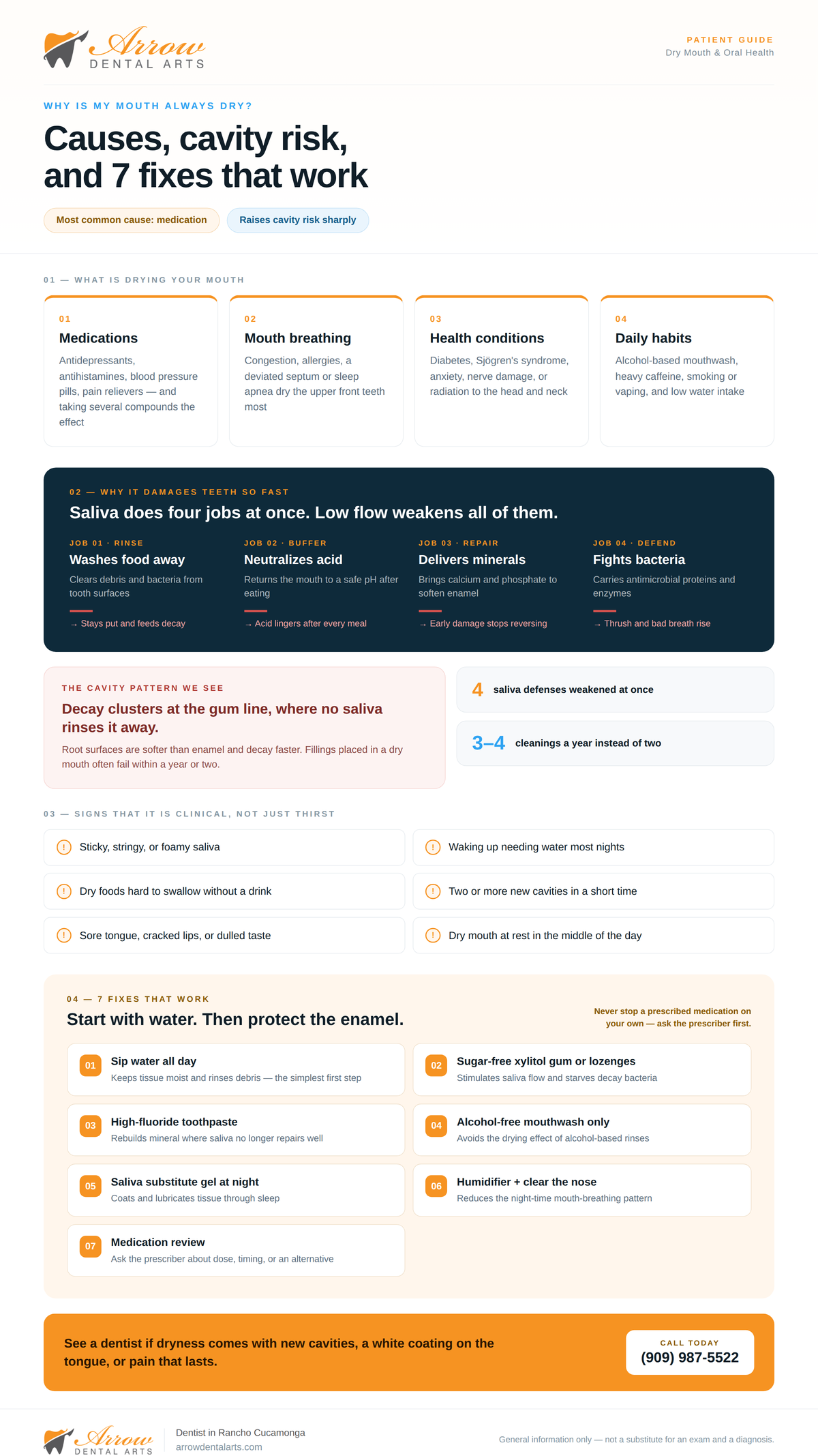
Medications are the leading cause, and the list is long: antidepressants and anti-anxiety drugs, antihistamines and decongestants, blood pressure medications including diuretics, muscle relaxants, opioid pain relievers, bladder-control drugs, and some acne and seizure medications. Taking several of them compounds the effect.
Mouth breathing is the most under-recognized cause. If you breathe through your mouth at night because of nasal congestion, allergies, a deviated septum, or sleep apnea, you wake with a dry mouth and a much higher risk of decay on the upper front teeth — the area dried out most by airflow.
Other contributors include diabetes (high blood sugar pulls fluid out of tissues), autoimmune conditions such as Sjögren’s syndrome, anxiety, smoking and vaping, alcohol including alcohol-based mouthwashes, heavy caffeine intake, dehydration, nerve damage from head or neck surgery, and radiation therapy to the head or neck, which can permanently reduce salivary gland function.
Why dry mouth damages teeth so quickly
Saliva does four jobs at once: it rinses food and bacteria off tooth surfaces, it neutralizes acid after eating, it delivers calcium and phosphate that repair early mineral loss, and it contains antimicrobial proteins. When flow drops, all four weaken at the same time.
The result is a recognizable pattern:
- Cavities at the gum line and on root surfaces, which are softer and decay faster than enamel
- Rapid recurrence — fillings placed and failing within a year or two
- Enamel erosion from lost buffering capacity, especially with acidic drinks
- Denture discomfort, since a dry mouth has no suction and tissue becomes irritated
This is why a dry mouth complaint changes our treatment plan: the same home care that keeps one patient stable will not protect someone with low saliva flow.
7 fixes that work
| Fix | How it helps |
|---|---|
| Sip water all day | Keeps tissue moist and rinses debris; the simplest first step |
| Sugar-free xylitol gum or lozenges | Stimulates saliva flow and starves decay bacteria |
| High-fluoride toothpaste | Rebuilds mineral in an environment that no longer repairs itself well |
| Alcohol-free mouthwash | Avoids the drying effect of alcohol-based rinses |
| Saliva substitutes | Coating sprays, gels, or melts that lubricate at night |
| Humidifier and nasal breathing | Addresses the night-time mouth-breathing pattern directly |
| Medication review | The prescriber may adjust dose, timing, or swap a culprit drug |
What a dentist can do about it
We start by confirming the pattern: which surfaces are dry, whether decay is clustering at the gum line, and whether erosion or thrush is present. From there the plan usually includes professional fluoride varnish at shorter intervals, prescription-strength fluoride for home use, sealants on exposed root surfaces, and a hygiene schedule tightened from six months to three or four.
We also review the medication list with you and, when a drug looks like the driver, encourage a conversation with your physician rather than a change on your own.
When to seek care
See a dentist promptly if you have persistent dryness with new or recurring cavities, a white coating on the tongue or cheeks, pain or burning that lasts, difficulty swallowing, cracked and bleeding lips, or dryness that began after starting a new medication. Mention it even if you think it is minor — the finding changes how we protect your teeth.
Arrow Dental Arts is a full-service practice in Rancho Cucamonga, and our dentist in Rancho Cucamonga regularly builds preventive plans for patients on multiple medications, patients with sleep-disordered breathing, and patients whose decay pattern points to low saliva flow.
Frequently asked questions
Can dry mouth cause cavities even if I brush twice a day?
Yes. Brushing removes plaque, but saliva neutralizes acid and repairs enamel between meals. With low saliva flow, the same brushing routine protects less, which is why fluoride treatments and more frequent cleanings are often added.
Is dry mouth reversible?
Sometimes. If a medication, dehydration, alcohol-based mouthwash, or mouth breathing is the cause, correcting it usually restores flow. If salivary glands are damaged by radiation or an autoimmune disease, dryness may be long-term and managed rather than cured.
Why is my mouth driest at night?
Saliva flow naturally drops during sleep, and mouth breathing multiplies the effect. A humidifier, nasal clearing, an alcohol-free rinse before bed, and a saliva substitute gel can all reduce morning dryness.
Should I stop my medication to fix dry mouth?
No. Never stop or change a prescription on your own. Ask the prescriber whether the dose, timing, or drug choice can be adjusted — there is often an alternative that is easier on saliva.

Dealing with constant dryness or a run of new cavities? Call Arrow Dental Arts at (909) 987-5522 to schedule an evaluation with our dentist in Rancho Cucamonga.